
Powder Coating vs Painting Wheels: Which Finish Holds Up Better?
· By Fabiano Pereira
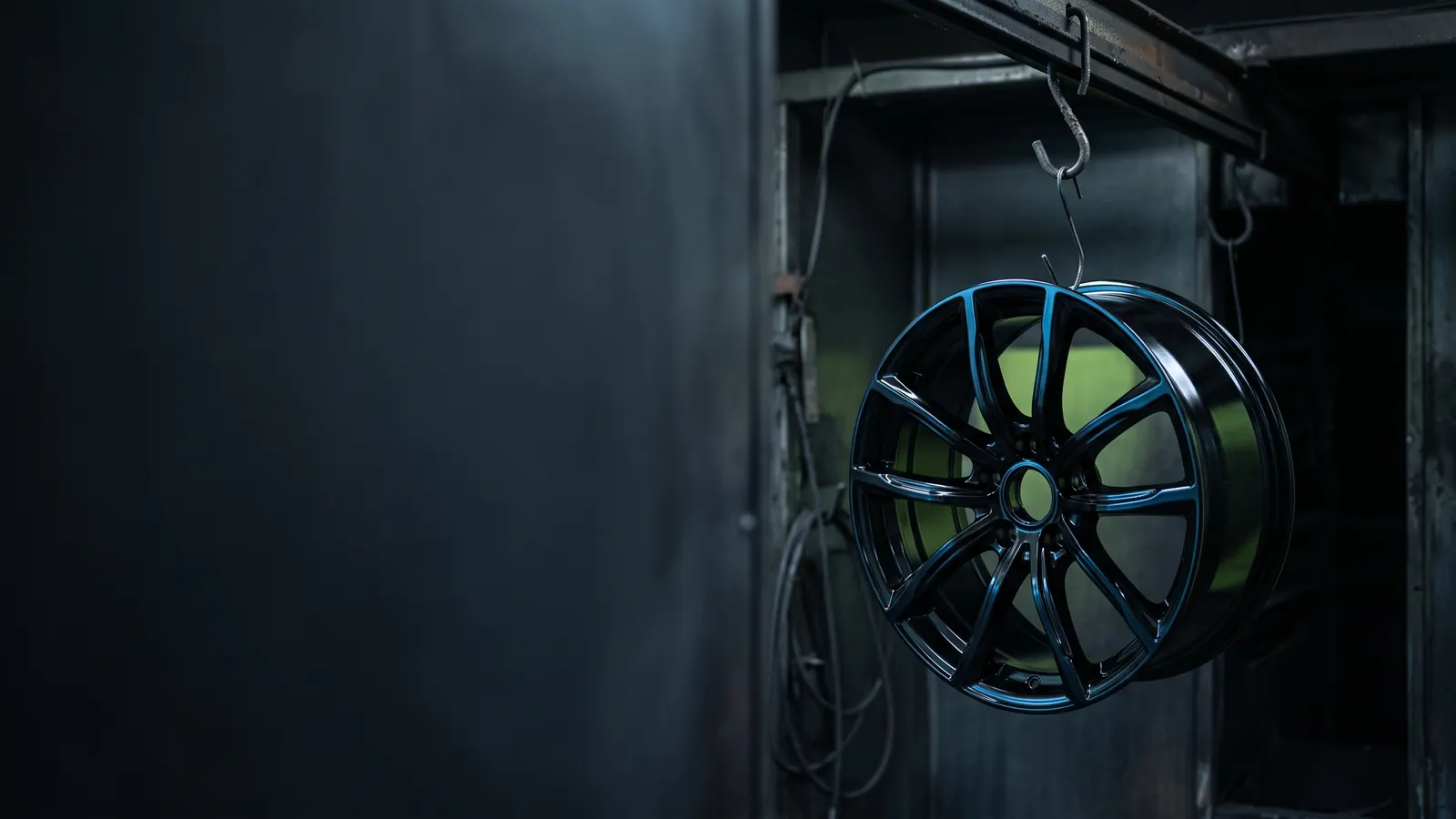
If your wheels are chipped, faded, or covered in curb rash, you have two main ways to refinish them: paint or powder coat. Both can look great on day one. The difference shows up a year or two later, after brake dust, road salt, pressure washers, and a few hundred potholes.
This guide compares the two honestly, including the cases where paint is the right call. The goal is to help you pick the finish that fits how you actually drive, not to sell you the more expensive option.
How each finish is applied
Paint is a liquid. It is sprayed in thin layers, usually primer, base color, and clear, and it dries as the solvents evaporate or as a catalyst cures it. Done in a professional booth with automotive urethane, it can look excellent. Done with a spray can in a driveway, it is a different story.
Powder coating uses a dry powder made of resin and pigment. The wheel is stripped to bare metal, the powder is sprayed on with an electrostatic gun so it clings to the grounded wheel, and then the wheel goes into an oven at roughly 400°F. The powder melts, flows out, and cross-links into one continuous hard shell.
That curing step is the key difference. Powder is not just drying on the surface; it is chemically hardening into a thicker, tougher layer than most paint systems.
Powder coating also has an environmental edge. Because it contains little to no solvent, it releases far fewer volatile compounds than liquid paint, and overspray can often be reclaimed. That does not change how your wheels look, but it is part of why the process has become the standard for wheels and industrial parts alike.
Durability: chips, salt, and brake dust
Powder coat is generally more resistant to chipping and impact than paint. It goes on thicker, typically two to three times the film thickness of a standard paint job, and it flexes slightly instead of cracking when a stone or tire iron hits it.
Chemical resistance matters a lot on wheels. Brake dust is hot, metallic, and corrosive. Wheel cleaners can be harsh. In Rhode Island and Massachusetts, winter roads are coated in salt and brine for months. Powder coat handles all of this better than most paints, which can stain, dull, or lift at the edges over time.
The weak point for any finish is a breach. Once a chip exposes bare aluminum, moisture and salt can creep underneath. Powder resists that creep better because it is bonded to properly blasted metal, but prep quality matters as much as the coating itself.
Cost comparison
DIY spray paint is the cheapest route by far, often well under $100 for materials. A professional paint job on wheels typically lands in a similar range to powder coating, and sometimes higher for complex multi-stage colors, because the labor of stripping, prepping, and masking is the same either way.
Powder coating at most shops runs roughly $100 to $250 per wheel for a standard finish, more for larger wheels or specialty effects. When you divide that by the years of service you get out of it, powder usually comes out ahead for a daily driver.
Where paint can save money is on a quick refresh for a car you are not keeping long, or a wheel with a diamond-cut face that cannot go through an oven without losing that machined look.
Look and color options
Paint has always been strong on color matching, and that is still true for exact OEM shades. But the powder palette has grown enormously. Suppliers like Prismatic Powders, which we use, offer thousands of colors and effects: gloss, satin, matte, metallics, candies, textures, and chrome-look finishes.
Powder also tends to give a very even, smooth finish without runs or sags, since it flows out in the oven rather than being brushed or sprayed wet. Gloss black, satin bronze, and gunmetal are the most requested wheel colors for good reason: they hide brake dust and look sharp.
Texture is another difference. Paint is almost always smooth. Powder can be smooth, wrinkle, sand, or hammertone textured, which some owners like on off-road and truck wheels because small scuffs disappear into the texture instead of standing out.
If you want a factory-style machined lip with a colored face, both methods can work, but the machined face itself usually needs a clear coat rather than a solid color to keep that bare-metal look.
Repairs and touch-ups
This is where paint has a real edge. A small chip in paint can be blended and touched up locally. Powder coat cannot be spot-repaired cleanly; fixing a damaged area usually means stripping and recoating the whole wheel.
In practice, that trade-off is less painful than it sounds, because powder chips less often in the first place. Still, if you track your car, hit a lot of curbs, or swap tires constantly with a tire machine that scratches, factor that in.
One practical tip: ask the shop for the exact color name and code they used. If a wheel ever needs recoating after a pothole, having that code on file makes it easy to match the rest of the set instead of redoing all four.
Cosmetic damage like curb rash should be repaired before either finish goes on. Covering it with color only hides it until the first wash.
Which should you choose?
Choose powder coating if the car is a daily driver, sees winter roads, or you want the finish to last several years with minimal fuss. That covers most people commuting around Providence, Warwick, or the Greater Boston area.
Paint can make sense for show cars that rarely see weather, for exact OEM color matches on a single wheel, for diamond-cut faces, or for a short-term refresh before a sale.
Not sure which fits your wheels? Text our Warwick, RI shop a photo and tell us how you use the car. We will tell you honestly which finish makes sense and send a free quote.
Frequently asked questions
- Is powder coating better than painting wheels?
- For most daily-driven wheels, yes. Powder coat is thicker, more chip resistant, and handles brake dust, salt, and wheel cleaners better than typical paint. Paint is still useful for exact OEM color matches, quick touch-ups, and wheels that cannot be oven cured.
- How long does powder coat last compared to paint on wheels?
- A well-prepped powder coat on wheels commonly lasts many years with normal care, often noticeably longer than a typical paint refinish. Prep quality, driving conditions, and cleaning habits affect both finishes.
- Can you touch up powder coated wheels?
- Not cleanly. Small chips can be dabbed with matching touch-up paint as a stopgap, but a proper repair means stripping and recoating the whole wheel. Powder chips less often than paint, which offsets this.
- Is powder coating wheels more expensive than painting?
- It is more expensive than DIY spray paint but often similar to a professional paint job, since stripping and prep labor is the same. Over the life of the finish, powder usually costs less per year.
Found this helpful? Make us a preferred source on Google.
Want a price for your wheels or parts?
Send a photo for a free ballpark quote. The final price is set when we see the part at the Warwick shop.